I enjoyed exploring the interactive film, Small World, by Florian Thalhofer, but I have to admit, I was slightly confused by it. I realize what it has to do with the narrative structures we have been talking about, but I can only guess what its relationship to space and postmodernism could be. At first it was difficult to enjoy the abstractness of the photos that were brought up, but after a few of them, I started appreciating them and recognizing their connection to the bits of story being told.
The narrative structure is obvious: once the scene is finished, squares pop up that you are allowed to click on. It seemed to me that the choices narrowed as you progress through the film. The little red box at the top right seemed to keep track of how many slides you had gone through. The narrative wasn’t continuous, because when I had gone through all the scenes, it told me it was “the end.” So rather than being a continuous story, it had one specific ending; how you got to the end was your own choice, though. The links to different pages related to each other. Even though they were on several different pages, I could tell that each grouping followed one another.
The relationship to space might refer to the placement of the boxes that you clicked on once the scene was finished. Something interesting that I noticed was that all of the music, except for one song, was from Americans bands. The one song that wasn’t from an American band was by Belle & Sebastian, a Scottish pop band, who also sings in English. This seemed a little different considering that the main version of the film is in German. When I went back to the site and watched the version in German, the songs were not played for as long as they were in the English version. Perhaps this was a way to make the English speakers feel more connected to the foreign origin of the film?
Sunday, November 16, 2008

Monday, November 10, 2008
Blog 10: Videodrome
Normally, I look forward analyzing videos or text for IML 101, but after seeing Videodrome, I was dreading it. Videodrome could perhaps be viewed as a form of “art,” but to me, it is an unnecessary focus on the perverted underworld of violence and sex. Never in my life would I have chosen to watch something like that. There are many other movies that could have applied to Marshall MacLuhan’s theories. Never will I willingly watch something like that again.
I was disturbed and upset by the film.
Since watching the movie, it has not seemed as bad as I thought at first, simply because my brain has tried to rationalize it. This horrifies me because I do not want to normalize any sort of behavior relating to the sadomasochistic smut that we watched. I have tried to block the movie from my mind.
I hate having to recall the movie, but since my grade depend upon it, I will now relate Cronenberg’s Videodrome to Marshall McLuhan’s theories:
McLuhan’s concept of a global village can be seen in Videodrome in the way that the main character is able to pick up channels being distributed from around the world.
McLuhan’s text states, “all media work us over completely.” This is also apparent in Videodrome in the way that the main character becomes so completely involved with his work that it becomes a part of his life away from work. He is apparently extra-receptive to the hallucinations because of his exposure to violence and sex in the media.
“We are enveloped by sound… We can’t shut out sound automatically.” – McLuhan. A reader can choose to look away from reading a book if it becomes distasteful. A listener cannot choose to close their “earlids” when they hear something they do not like. When the main character is watching Dr. Oblivion’s videos and hallucinating, looking away will not stop him from experiencing the sounds of the recording. He could have shut the TV off (but perhaps the hallucination’s grasp on him were too strong), but otherwise, he was plagued by the sound coming from the television.
“In television, the images are projected at you. You are the screen. The images wrap around you. You are the vanishing point.” – McLuhan. The first part of the quote is relevant to the movie because the main character’s job depends on sampling media for his television channel’s audience. The second part of the quote is relevant in a whole different level because the screen stimulates the hallucinations and they take hold of the audience.
I was disturbed and upset by the film.
Since watching the movie, it has not seemed as bad as I thought at first, simply because my brain has tried to rationalize it. This horrifies me because I do not want to normalize any sort of behavior relating to the sadomasochistic smut that we watched. I have tried to block the movie from my mind.
I hate having to recall the movie, but since my grade depend upon it, I will now relate Cronenberg’s Videodrome to Marshall McLuhan’s theories:
McLuhan’s concept of a global village can be seen in Videodrome in the way that the main character is able to pick up channels being distributed from around the world.
McLuhan’s text states, “all media work us over completely.” This is also apparent in Videodrome in the way that the main character becomes so completely involved with his work that it becomes a part of his life away from work. He is apparently extra-receptive to the hallucinations because of his exposure to violence and sex in the media.
“We are enveloped by sound… We can’t shut out sound automatically.” – McLuhan. A reader can choose to look away from reading a book if it becomes distasteful. A listener cannot choose to close their “earlids” when they hear something they do not like. When the main character is watching Dr. Oblivion’s videos and hallucinating, looking away will not stop him from experiencing the sounds of the recording. He could have shut the TV off (but perhaps the hallucination’s grasp on him were too strong), but otherwise, he was plagued by the sound coming from the television.
“In television, the images are projected at you. You are the screen. The images wrap around you. You are the vanishing point.” – McLuhan. The first part of the quote is relevant to the movie because the main character’s job depends on sampling media for his television channel’s audience. The second part of the quote is relevant in a whole different level because the screen stimulates the hallucinations and they take hold of the audience.
Sunday, November 2, 2008
Blog 9: The Postmodern Flâneur
"Flâneur" is a word understood intuitively by the French to mean "stroller, idler, walker." He has been portrayed in the past as a well-dressed man, strolling leisurely through the Parisian arcades of the nineteenth century--a shopper with no intention to buy, an intellectual parasite of the arcade. Traditionally the traits that mark the flâneur are wealth, education, and idleness. He strolls to pass the time that his wealth affords him, treating the people who pass and the objects he sees as texts for his own pleasure.
- http://www.thelemming.com/lemming/dissertation-web/home/flaneur.html
As an extension of this definition, a postmodern flâneur could be defined as the online world – browsing the Internet for information or goods. After going through the online world of Second Life, it is obvious that it can be defined as a “postmodern flâneur” as well.
Once my account was set up, and I had downloaded the program, it took me to a part of the Second Life world for a tutorial. It walked me through the steps of how to control my character’s movements and how to change the looks of my character, or avatar as they were calling it. The funny thing about “avatars” is that in most other cases that I’ve known of or had avatars, they were still, small, square image; not moving, interacting characters. As I was walking and flying around (because in Second Life, that is possible), another character came up to me and started talking. Normally, in a video game, it is only a computer-generated character you are interacting with; in Second Life, you are interacting with any human who has internet capabilities. There are so many warnings out there now about not talking to strangers in the online world, much the same as warning about strangers in the real world. A key difference, though, is that online strangers have the capabilities to hack into your computer, which stores tons of personal information that you might not have in any other location. So, I decided not to “talk with” the person who came up to me.
After walking around for a while, I decided to try and leave this learning stage of the Second Life world. It took me a while to figure out, but I finally “teleported” to another location. There was a lot I wanted to try and do, but because I lacked the knowledge of how to do things, I felt limited. I also didn’t want to get involved in a role-play sort of thing or sent on a mission anywhere. This seems to make it similar to a window-shopping experience in that you do not have to get involved. A user in Second Life can merely be a passive player in the game. It seems like a lot of time has to be invested if you want to accomplish anything in the game.
While the world is quite extensive, there are still glitches in the graphics. When I was trying to get into a place that seemed like a mall, I tried flying in, but then the walls closed in front of me and wouldn’t let me through. And when I was changing the looks of my character, it wouldn’t always do it correctly. I changed the type of shoe my character was wearing and it ended up looking like she had huge holes in her shoes because her feet were sticking out. These sort of things wouldn’t happen in the real world.
One of the major differences between walking though a fake world and through the real one is that there are no smells in the fake world. I remember reading something in a psychology class junior year that our sense of smell is the only one that goes directly to the cortex of the brain, bypassing the thalamus. This allows us to link smells more directly with memories and emotions. Just yesterday as I was walking to the football game, I thought of camping because it smelled like rain and fires. My friends experienced a similar sensation. In the world of Real Life, there aren’t any smells to trigger memories.
Sunday, October 26, 2008
Blog 8: Multimedia Genre - Narrative
First of all: when I saw The Way Things Go video, I was immediately reminded of the Honda Accord Commercial that I saw from an email. The text of the email is as follows:
Here’s the link to the video: http://www.youtube.com/watch?v=uyN9y0BEMqc
I have seen various other movies before in which inanimate objects independently affect each other in order to create another response that repeatedly triggers action, as seen in the Honda Accord commercial and in The Way Things Go. Perhaps it is because I do not know the maker’s intent in The Way Things Go, but the Honda commercial seems to have a greater purpose and limitations that the engineers overcame, making me more in awe of the footage. Perhaps it’s also because I know the other background facts about the Honda commercial (606 takes, 6 million dollars to film, etc). It seems like there is greater creativity in the Honda commercial, because they were limited to using the car they were promoting (similar to the film style in Leth and von Trier’s film, The Five Obstructions). The narrative seemed self-explanatory; the objects were acting upon each other to prompt the motion of the next.
While I didn’t fully understand the narrative in The Way Things Go, Soft Cinema seemed to have more of a point behind it. Practically all cultures have symbols and colors that have specific meanings. Colors, for example, indicate seasons, teams, and even emotions. The combination of colors, images, text, and sound form what seems to be a more realistic representation of how our brains recall memories. Humans don’t have a perfect memory; details are often left out in exchange for emotions. Soft Cinema was confusing to watch at first, but made more sense as I adjusted to watching it. It’s one thing to think of one’s brain processing and recording memories in the manner Soft Cinema does, but it’s another to watch it on a screen. Watching the video seemed to almost require a passive viewer who didn’t concentrate too hard on the separate pieces of the movie, rather digested it as a whole.
If you thought that the people who set up a room full of dominoes to have them knocked over later was amazing, you haven't seen anything yet. There are no computer graphics or digital tricks in these images. Everything that you see happened in real time exactly as you see it.
The recording required 606 takes and in the first 605 takes there always was something, usually of minor importance, that didn't work. It was necessary for the recording team to install the set-up time after time and it took several weeks working day and night to achieve this effect. The recording cost 6 million dollars and it took 3 months to finish,
including the engineering design of the sequence. The duration of the video is only 2 minutes, but every time that Honda shows the commercial on British television, they make enough money to support any of us for the rest of our lives. However, this commercial has turned out to be the most displayed in the history of the Internet. Honda execs think that it will pay for itself simply because of the free showings (Honda is not paying one cent for you to see it) When Honda senior execs viewed it, they immediately approved it without hesitation-including costs.
There are only six Honda Accords built by hand in the whole world, and to the horror of Honda engineers, the recording team disassembled two of them for the recording. Everything you see in the sequence (besides the walls, floor, ramp and untouched Honda Accord) is part of those two automobiles. The voice is that of Garrison Keiller. The commercial was so well received by Honda execs when they saw it, that their first comment was how amazing the computer graphics were. They almost fell out of their chairs when told that the recording was real without any graphics manipulation
By the way, about the wind shield wipers in the new Honda Accords, they are sensitive to water and designed to start working as soon as they get wet.
Here’s the link to the video: http://www.youtube.com/watch?v=uyN9y0BEMqc
I have seen various other movies before in which inanimate objects independently affect each other in order to create another response that repeatedly triggers action, as seen in the Honda Accord commercial and in The Way Things Go. Perhaps it is because I do not know the maker’s intent in The Way Things Go, but the Honda commercial seems to have a greater purpose and limitations that the engineers overcame, making me more in awe of the footage. Perhaps it’s also because I know the other background facts about the Honda commercial (606 takes, 6 million dollars to film, etc). It seems like there is greater creativity in the Honda commercial, because they were limited to using the car they were promoting (similar to the film style in Leth and von Trier’s film, The Five Obstructions). The narrative seemed self-explanatory; the objects were acting upon each other to prompt the motion of the next.
While I didn’t fully understand the narrative in The Way Things Go, Soft Cinema seemed to have more of a point behind it. Practically all cultures have symbols and colors that have specific meanings. Colors, for example, indicate seasons, teams, and even emotions. The combination of colors, images, text, and sound form what seems to be a more realistic representation of how our brains recall memories. Humans don’t have a perfect memory; details are often left out in exchange for emotions. Soft Cinema was confusing to watch at first, but made more sense as I adjusted to watching it. It’s one thing to think of one’s brain processing and recording memories in the manner Soft Cinema does, but it’s another to watch it on a screen. Watching the video seemed to almost require a passive viewer who didn’t concentrate too hard on the separate pieces of the movie, rather digested it as a whole.
Sunday, October 19, 2008
Blog 7: Scientific Visual Culture
The goal of each of the “artists” from the Critical Art Ensemble website seems be to generate dialogue about the subject they are discussing. Some of the artists go so far as to create a “cult” as the “Cult of the New Eve” does. They “worship” the New Eve by parodying text from the Bible, using the same font and graphics as medieval versions of the Bible did, etc. They even manipulate actual pictures from the Renaissance and other art periods in order to insert people with their cult’s garb (red cloaks and dark glasses) as seen in this picture:
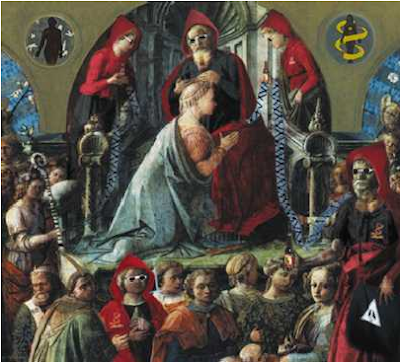
Flesh Projet by BioCom seems to support biotechnology as it discusses biotechnology as a means to grow new organs and tissues. It also talks about discovering the secrets of the code that programs the DNA – the proteins A, C, T, and G. “This recombinant DNA is essential for the redesign of the body for specific, goal-oriented tasks that better complement its interface with technology within the real space of production. Human characteristics must also be rationally designed and engineered in order to eliminate body functions and psychological characteristics that refuse ideological inscription.” (http://www.critical-art.net/biotech/biocom/biocomWeb/dnatest.html)
While most of the projects seem to have a definite opinion on whether biotechnology is ethical or whether it should be pursued, it seems like that message matters less than the result of getting people to discuss whether it is or not. They just want to bring it into public attention.
Biotechnology and deciphering the human DNA relates to scientific visual culture as we discussed in class because by discovering which parts of the DNA modify our phenotypic traits. These traits include eye color, height, skin color, or the shape of your nose. By completely understanding DNA and genetics, scientists will also be able to decide whether people are defined by “nature” or “nurture.” With this technology, it will also allow us to project what future generations will look like as cultures become more connected and overlapping. In other words, as the world becomes more of a monoculture and interbreeds, scientists will be able to forecast what affects it will have on humans. If scientists know exactly how the DNA correlates to all aspects of the body, they will be able to predict whether an unborn baby will have learning disabilities or exceptional athletic ability. Scientists will be able to catalogue traits before they have been developed as opposed to after they were developed as Eadweard Muybridge found with his Motion Studies in the 1880s.

Flesh Projet by BioCom seems to support biotechnology as it discusses biotechnology as a means to grow new organs and tissues. It also talks about discovering the secrets of the code that programs the DNA – the proteins A, C, T, and G. “This recombinant DNA is essential for the redesign of the body for specific, goal-oriented tasks that better complement its interface with technology within the real space of production. Human characteristics must also be rationally designed and engineered in order to eliminate body functions and psychological characteristics that refuse ideological inscription.” (http://www.critical-art.net/biotech/biocom/biocomWeb/dnatest.html)
While most of the projects seem to have a definite opinion on whether biotechnology is ethical or whether it should be pursued, it seems like that message matters less than the result of getting people to discuss whether it is or not. They just want to bring it into public attention.
Biotechnology and deciphering the human DNA relates to scientific visual culture as we discussed in class because by discovering which parts of the DNA modify our phenotypic traits. These traits include eye color, height, skin color, or the shape of your nose. By completely understanding DNA and genetics, scientists will also be able to decide whether people are defined by “nature” or “nurture.” With this technology, it will also allow us to project what future generations will look like as cultures become more connected and overlapping. In other words, as the world becomes more of a monoculture and interbreeds, scientists will be able to forecast what affects it will have on humans. If scientists know exactly how the DNA correlates to all aspects of the body, they will be able to predict whether an unborn baby will have learning disabilities or exceptional athletic ability. Scientists will be able to catalogue traits before they have been developed as opposed to after they were developed as Eadweard Muybridge found with his Motion Studies in the 1880s.
Sunday, October 12, 2008
Blog 6: An Inconvenient Truth
The message trying to be argued in Davis Guggenheim’s film, An Inconvenient Truth, is that global warming is occurring and that the general populous needs to change their consumption and conservation habits.
Al Gore traveled the world giving a power point presentation reflecting this message and the movie shows his presentation, follows some of his travels while he narrates the whole thing. Most laypeople would have been extremely bored had they just chosen to record his presentation. Instead, the moviemakers decided to put Al Gore’s personal (and sometimes only vaguely relevant) anecdotes in amongst the footage of the presentation. Another key tactic they use to keep viewers engaged is making references to popular culture or at least by using metaphors. For example, toward the beginning of the film, they show a short, dumbed-down version of global warming presented by an newscaster in Simpson’s style cartooning. They also relate the Earth and its atmosphere to a globe with a coat of varnish. I think it’s also critical when analyzing how the stance is developed to notice that most of the “current” pictures shown of the environment all have red, smoky backgrounds. The color red also has the connotation of having to do with violence, blood, and forbidden or negative things, which affects subconscious readings of the pictures.
Mr. Gore and Mr. Guggenheim are trying to portray their film as presenting the truth by referencing “scientists” all the time. They also seem to want to show Mr. Gore as a scholarly, reliable common-man type. They paint his childhood as atypical, but he still supposedly kept his roots by living 4 months of the year on a farm. When Mr. Gore isn’t shown giving a presentation in the movie, he is on his laptop. It seems impossible that he would be making changes to the presentation every spare moment he had; even while other people on the plane are sleeping, he is vigilantly working on his laptop. An Inconvenient Truth seems to have a personal aspect to it, like Brzeski’s film, but it seems more scientific and factual, like Faden’s film (despite the fact that Faden’s film ends up being a fake old movie). Both Brzeski’s film and Guggenheim’s employ the use of metaphors, though in different manners, in order to give more substance to their argument.
Gore and Guggenheim want the audience to realize that global warming is occurring at a rate that must be slowed down as soon as possible. In the movie, Gore asks questions that seem to prompt action, “Future generations may well have occasion to ask themselves, "What were our parents thinking? Why didn't they wake up when they had a chance?" We have to hear that question from them, now.”
As a side note:
I have to admit, I am slightly biased against this movie due to previous articles I have read:
http://www.snopes.com/politics/bush/house.asp
http://www.guardian.co.uk/world/2007/feb/28/film.usa2
http://www.wnd.com/index.php?fa=PAGE.view&pageId=64734
http://www.snopes.com/politics/war/sendler.asp
http://www.eyeblast.tv/public/checker.aspx?v=Q4prVr4z
Those are a few. I also had heard about his “carbon credits” and found these articles on that:
http://riehlworldview.com/carnivorous_conservative/2007/03/al_gores_inconv.html
http://www.worldnetdaily.com/news/article.asp?ARTICLE_ID=54528
http://www.usatoday.com/news/opinion/editorials/2006-08-09-gore-green_x.htm
The last paragraph of the last article asks a question that I find pertinent to the matter:
“The issue here is not simply Gore's hypocrisy; it's a question of credibility. If he genuinely believes the apocalyptic vision he has put forth and calls for radical changes in the way other people live, why hasn't he made any radical change in his life?”
Al Gore traveled the world giving a power point presentation reflecting this message and the movie shows his presentation, follows some of his travels while he narrates the whole thing. Most laypeople would have been extremely bored had they just chosen to record his presentation. Instead, the moviemakers decided to put Al Gore’s personal (and sometimes only vaguely relevant) anecdotes in amongst the footage of the presentation. Another key tactic they use to keep viewers engaged is making references to popular culture or at least by using metaphors. For example, toward the beginning of the film, they show a short, dumbed-down version of global warming presented by an newscaster in Simpson’s style cartooning. They also relate the Earth and its atmosphere to a globe with a coat of varnish. I think it’s also critical when analyzing how the stance is developed to notice that most of the “current” pictures shown of the environment all have red, smoky backgrounds. The color red also has the connotation of having to do with violence, blood, and forbidden or negative things, which affects subconscious readings of the pictures.
Mr. Gore and Mr. Guggenheim are trying to portray their film as presenting the truth by referencing “scientists” all the time. They also seem to want to show Mr. Gore as a scholarly, reliable common-man type. They paint his childhood as atypical, but he still supposedly kept his roots by living 4 months of the year on a farm. When Mr. Gore isn’t shown giving a presentation in the movie, he is on his laptop. It seems impossible that he would be making changes to the presentation every spare moment he had; even while other people on the plane are sleeping, he is vigilantly working on his laptop. An Inconvenient Truth seems to have a personal aspect to it, like Brzeski’s film, but it seems more scientific and factual, like Faden’s film (despite the fact that Faden’s film ends up being a fake old movie). Both Brzeski’s film and Guggenheim’s employ the use of metaphors, though in different manners, in order to give more substance to their argument.
Gore and Guggenheim want the audience to realize that global warming is occurring at a rate that must be slowed down as soon as possible. In the movie, Gore asks questions that seem to prompt action, “Future generations may well have occasion to ask themselves, "What were our parents thinking? Why didn't they wake up when they had a chance?" We have to hear that question from them, now.”
As a side note:
I have to admit, I am slightly biased against this movie due to previous articles I have read:
http://www.snopes.com/politics/bush/house.asp
http://www.guardian.co.uk/world/2007/feb/28/film.usa2
http://www.wnd.com/index.php?fa=PAGE.view&pageId=64734
http://www.snopes.com/politics/war/sendler.asp
http://www.eyeblast.tv/public/checker.aspx?v=Q4prVr4z
Those are a few. I also had heard about his “carbon credits” and found these articles on that:
http://riehlworldview.com/carnivorous_conservative/2007/03/al_gores_inconv.html
http://www.worldnetdaily.com/news/article.asp?ARTICLE_ID=54528
http://www.usatoday.com/news/opinion/editorials/2006-08-09-gore-green_x.htm
The last paragraph of the last article asks a question that I find pertinent to the matter:
“The issue here is not simply Gore's hypocrisy; it's a question of credibility. If he genuinely believes the apocalyptic vision he has put forth and calls for radical changes in the way other people live, why hasn't he made any radical change in his life?”
Sunday, October 5, 2008
Blog 5: Brzeski & Faden
“Certain subjects… may be termed ‘cinematic’ because they seem to exert a peculiar attraction on the medium. It is as if the medium were predestined (and eager) to exhibit them.” – Sigfried Kracauer, Theory of FilmThis quote prefaces Tracking Theory: The Synthetic Philosophy of The Glance, By Eric S. Faden. In both his movie and Eva Ilona Brzeski’s film, This Unfamiliar Place, they introduce their main plot by using a story or an anecdote to capture the readers’ attention. Brzeski’s story of being “intrigued by disaster” as a little girl seems to flow easier into the main story about her father. Faden’s whole film covers a much broader topic; he sets up his film by showing the three movies that inspired him, Wong Kar Wai's 2046, Lars Von Trier's Europa, and Gustavo Mosquera's Moebius, describing their themes, and his interpretation of them.
Brzeski’s film seems to be a personal exploration of her family. The narrator seems to be speaking from Brzeski’s point of view and the whole film has a dreamlike quality about it. The footage is mostly smooth and slow with audio playing on top of the images. Usually during an interview or the narration, there is music or whistling or nature sounds. Even the happy clip of her parents dancing at the end is slowed down. The visual imagery of that clip, though, is contrasted with the father’s words being spoken over it: “some of those things I don’t even think about. You know, I don’t even want to remember.” His life now seems to be a dream after the nightmare of Nazi occupation. There are a few clips of “destruction” – literal interpretations of the narrator’s words at the beginning—but even these seem to be slowed down and have music or narration over them, making them not seem quite as scary. They seem more to be a memory than an actual event taking place.
In my micro-seminar I took during Welcome Week with Michael Renov, we read two chapters of the book Collecting Visible Evidence. (I just found out that he was a co-editor of this book.) One of the strategies we discussed was that of “coimplication,” which was defined as “a kind of supplementary autobiographical practice; it functions as a vehicle of self-examination, a means through which to construct self-knowledge through recourse to the familial other.” This idea is visible in Brzeski’s film; she learns more about herself through exploring her father’s past. At one point in the film, you can tell that he is speaking directly to his daughter who is filming him. He says, “I would like to talk about other things if I have a choice, do I?” This part refers to Renov’s theory of “textual authority,” in which the “filial obligation outpaces directorial control.” She probably wasn’t expecting her father to turn around the interview and ask her questions. This exchange wouldn’t be possible if he was someone she didn’t know very well, but because he is her father, that usurpation of power is possible.
Faden begins his story with a different sort of personal anecdote. It definitely doesn’t feel as intimate as the story from Brzeski’s childhood, but his film isn’t as personal as hers seems to be. The whole introduction seemed a collage of words, video and audio clips. While the narrator was speaking, you could also hear other clips of audio as well as see words float across the screen. This modern compilation of media segued into an old time looking movie. At first, I was convinced I was looking at an authentic old piece of film, especially because the narrator had said, “By coincidence, when doing archival research last year, I stumbled upon the very movie that I had dreamed.” But after I heard one of the people in the film speak, I was pretty sure it wasn’t; I don’t think they had the technology to produce sound with the visuals when that type of filming was being done. I thought it was interesting how the narration preceding the old movie exactly described it.
“I thought about a long ago time when movies did more than just tell stories. A time when exhibitors edited fragments together and lecturers supplemented the visual spectacle with details and knowledge.”I also really liked the ending, where it jolts the viewer back to the present with a SUV driving across the screen and going from black and white, grainy film to colored, smooth-looking, modern film.
Both movies had references to trains, although Faden’s examples of them were much more direct. In Brzeski’s film, a train is shown when she is talking about her trip as a twelve year old to the alps while her father wrote his memoirs. Both movies use film clips as metaphors to further the meaning of their words. In Faden’s film, he uses abstract images along with the narration. They don’t necessarily seem to be metaphors as much of the time as literal representation of what he is saying. He shows people working with the footage while discussing finding the archival footage and clips of old movies while talking about them. One instance where it does seem to be a metaphor is when he says he “stumbled upon the very movie” and the clip being shown is of two trains crashing into each other. It makes it seem like he has “crashed” head-on to the conclusion he is making about film. Brzeski uses clips of rain and the sound of rain, which seems to be a sign of renewal. Her father’s life is new and the old parts are washed away; he has forgotten about his old life because he’s so involved with his life now. There is also a clip of empty carnival rides that has the audio over it saying she was “anticipating a reaction that never came.” I think using the visual clips in addition to the narration is an extremely effective way to saturate the viewer with the desired meaning.
Subscribe to:
Posts (Atom)